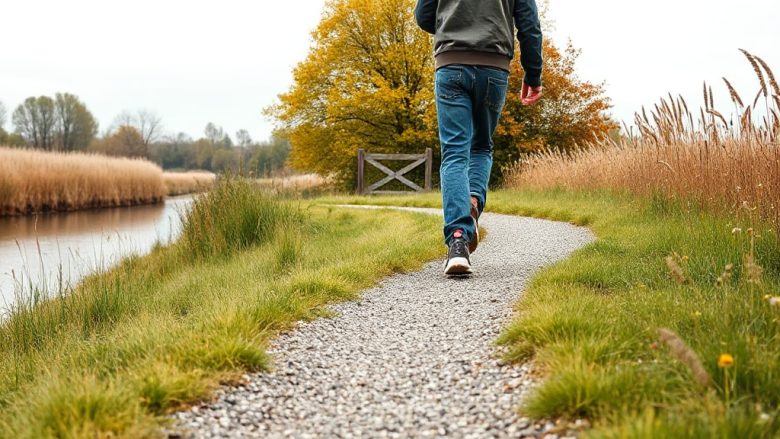
If you have ever scrolled past photos of people striding across windswept moors and quietly decided that kind of thing is not for you, this article is for you. Learning how to get started with nature walks does not require a waterproof jacket with a lifetime guarantee, a car full of gear, or legs that can climb a hill without complaining. It can be twenty minutes on a paved path five minutes from your front door, in the shoes you already own, wearing whatever coat is hanging by the door.
I lead short local walks for people who have never thought of themselves as outdoorsy. The pattern I see again and again is that the hardest part is not the walking. It is the story people tell themselves beforehand: that they are too unfit, too busy, too unsure about where to go. So let us take the pressure off. The only real requirement for a nature walk is showing up. Everything else is adjustable, and most of it matters far less than you think.
Choosing a first route that works for you
The best first route is the one you can reach without a planning session. Start with where you already are. Most towns and cities have a park with a perimeter path, a canal towpath, a riverside trail, or a patch of woodland at the edge of a housing estate. These are not lesser versions of nature. A canal bank with ducks, nettles and a heron is a genuine habitat, and it is far more likely to become part of your routine than a mountain you have to drive two hours to reach.
When you are picking that first route, look for three simple things. First, a surface you feel steady on. Tarmac, compacted gravel and boardwalk are all perfectly good walking surfaces, and using them is not cheating. Second, a loop rather than an out-and-back, if you can find one, because a loop feels like a small journey and gives you a natural place to stop. Third, somewhere to sit. A bench halfway round is a gift. It turns a walk into a pause, and pauses are where you actually start noticing things.
Length matters less than you would guess. A route of half a mile to a mile is plenty for a first outing. If you are unsure of the distance, check how long it takes you to walk to the local shop and back, then use that as your rough measure. Ten minutes out, ten minutes back is a complete nature walk. Nobody is marking it.
Timing matters too. Early morning is quiet but can feel exposed if you are self-conscious. Mid-morning on a weekday is often the calmest window in a local park. Late afternoon brings out dog walkers, who are usually the friendliest people you will meet on a path and will happily tell you which way the route goes. If you feel nervous about being alone, choose a route with other people on it. Busy is not the enemy of nature; it is just a different atmosphere.
One practical tip that saves a lot of faff: walk the route once in your head before you go. Look at a map, note where you enter, note where you turn, and note what the path looks like at that turn. A gate, a bridge, a row of lime trees, a particular bench. You are not memorising a route, just giving yourself two or three landmarks so you are not checking your phone every few minutes.
What to bring, and what to leave behind
The list of things you need is short, and the list of things you do not need is much longer. You need shoes you can walk in comfortably for half an hour. Trainers are fine. Wellies are fine in winter. You do not need walking boots for a paved path, and you certainly do not need to buy them before your first walk. If your feet are warm and dry and not rubbing, you are correctly equipped.
You need a layer you can take off. Walking warms you up faster than you expect, and the classic beginner mistake is to dress for standing still. A thin fleece or a light jacket over a t-shirt, plus a waterproof shell if rain is likely, covers almost every British day. Avoid jeans if you can; they get heavy and cold when damp. Any trousers that let you bend your knees freely will do.
You need water, even on a short walk, and a small snack if you are going out before breakfast. You need your phone, mainly so you feel safe, but put it in a pocket rather than your hand. That single habit changes the whole experience. You cannot notice a woodpecker or the smell of wet leaves while you are reading a screen.
What to leave behind is just as important. Leave the ambitious route you found online that is three times longer than you are ready for. Leave the idea that you need binoculars, a bird book, a fitness tracker or a special app to make the walk count. Leave the pressure to cover distance or hit a pace. And leave the expectation that you will see something spectacular. Most nature walks are quiet and ordinary, and that is not a failure. It is the point.
If you do want one small piece of kit, make it a cheap magnifying glass or a small notebook. Both cost very little and both slow you down in a good way. Looking closely at a leaf, a seed head or a patch of moss is where the interest actually lives.
A simple twenty-minute walk plan
Here is a plan you can use on your very first outing. It takes twenty minutes and it has a shape, which helps if you are the sort of person who feels aimless without one.
Spend the first five minutes just walking. No stopping, no looking around deliberately. Let your breathing settle and your shoulders drop. This is the warm-up, and it is also the bit where your brain stops churning through your to-do list.
For the next five minutes, pick one thing to pay attention to. Not everything. One thing. Sound is a good choice, because it is easy and it works anywhere. Count how many different sounds you can hear: traffic, a crow, wind in leaves, water, your own footsteps, someone’s radio. Or pick colour and look for every shade of green you can find. Or pick movement and watch for anything that shifts. This is the part of the walk where nature stops being scenery and becomes something you are actually doing.
Then spend five minutes standing still somewhere. This feels strange for about thirty seconds and then it feels wonderful. Stand at a viewpoint, a bridge or a bench and simply stay put. Stillness is the single most effective wildlife-watching technique there is. Birds and small mammals that hide from movement will often reappear within a minute or two of you stopping.
Use the final five minutes to walk back, and let your mind wander. Do not try to identify anything or remember anything. Just walk. On the way home, notice one thing you would like to know the name of. A tree, a flower, a bird call. That is your homework, and you can look it up later if you feel like it, or not.
That is the whole plan. It works in a city park, on a towpath and in a wood. You can repeat it every time you go out, or use it once and then let your own curiosity take over. Either is fine.
How to build the habit without forcing it
Habits stick when they are small, specific and easy to keep. So make your nature walk small, specific and easy. Instead of promising yourself you will get outdoors more, decide that you will walk the same short loop every Tuesday and Saturday morning. Same route, same time, same shoes by the door. Repetition is not boring here; it is how you start to see change. The same path in October and the same path in April are two different places, and noticing that difference is one of the quiet pleasures of walking regularly.
Attach the walk to something you already do. Walk after you make your morning coffee. Walk before you sit down to work. Walk while you are waiting for something to finish. Anchoring a new habit to an existing one is far more reliable than relying on motivation, which comes and goes.
Keep a note of what you see, but keep it tiny. A single line in your phone’s notes app is enough: two magpies, first daffodil, path flooded at the bottom. Over a few months, that list becomes a record of your own local seasons, and it is surprisingly satisfying to read back.
Let bad weather be part of it rather than a reason to skip. A walk in drizzle is often the most atmospheric one you will take. The path is empty, the colours are richer, and the smell of wet earth is worth the damp hood. If you genuinely cannot face it, walk for five minutes and come home. Five minutes still counts, and it keeps the habit alive.
Finally, do not wait until you feel like an outdoorsy person. Nobody feels like that at the start. You become one by going out, in ordinary clothes, on ordinary paths, for short amounts of time, again and again. That is all it takes. Your first nature walk is not a test and there is no standard to meet. Put your shoes on, step outside, and see what is there.